Here’s another lesson from a founder building AI that goes beyond the chatbot. David Eberle and Janis Berneker are the people behind Typewise, which they founded in Zurich in 2019. They met in high school in Switzerland when they were 14. Their first product was a smartphone keyboard that guessed what you wanted to type, built on their own language models. Before that, David worked as a consultant at Booz & Company and did an MBA at INSEAD.
The keyboard got around three million installs. But the real business turned out to be customer service. Typewise brought its technology to big companies, went through Y Combinator in 2022, and now works with brands like Unilever, DPD and Beurer. In September 2026, they launched Nova, a tool that sets up, tests and keeps improving a company’s AI support agents. It was the number one product on Product Hunt that day.
David answered all ten of our questions by email. We talked about why they left consumer apps behind, what an AI agent should really do, how you know a problem is fixed, and who should be in charge once the AI goes live.
Q&A with David Eberle
What prompted Typewise’s move from consumer keyboards to enterprise customer experience?
Our keyboard reached around three million installs across many languages. We built our own language models for text prediction, then brought that technology into enterprise customer service to help people write faster and better.
After deploying it at more than 60 enterprises, we had learned a lot about how customer operations actually work. Meanwhile, the technology had advanced enough to do much more than help someone write a reply. AI could understand a request, look up information and take action across business systems.
That led us to the AI concierge idea. Rather than putting a bot in front of an existing service process, we could rethink the experience itself. A prospect could get help choosing a product; a customer could get an order changed or a problem investigated. The concierge understands the person and their context, brings in the right AI specialist or human expert, and helps carry the request through. That’s a much bigger opportunity than making an existing task a little faster.
What should a true AI agent be able to do?
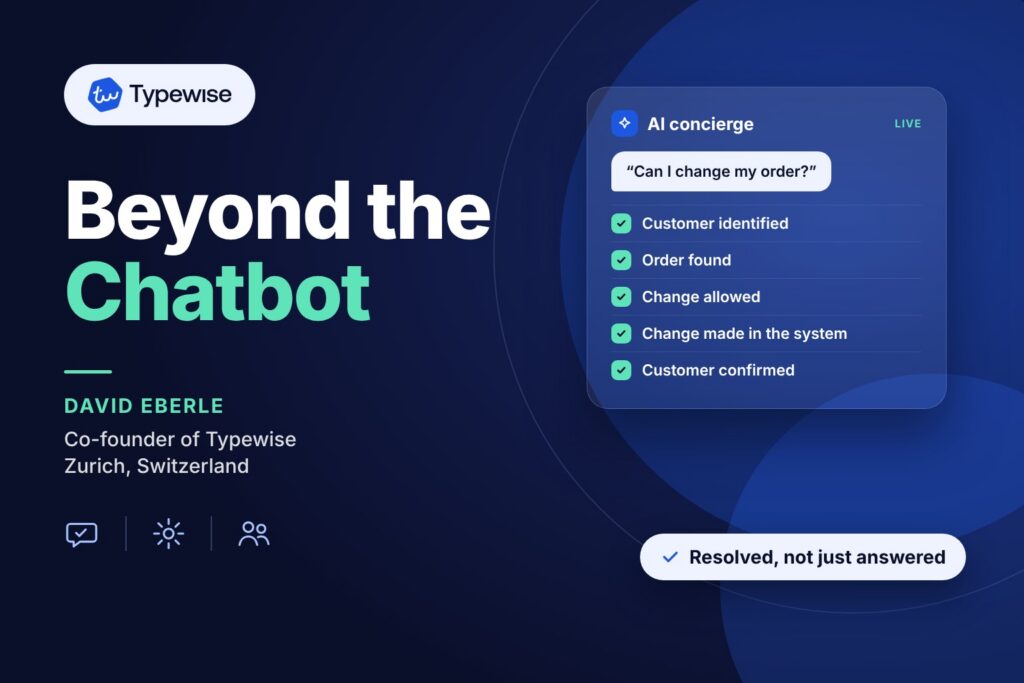
It should work toward an outcome, not just produce an answer. If a customer asks to change an order, describing the cancellation policy isn’t enough. The AI needs to identify the customer and order, check what’s possible, carry out the permitted change and confirm what actually happened.
That takes context, access to the right systems and the ability to coordinate several steps. It also needs to recognize uncertainty, missing information and the limits of its authority. Sometimes the right next step is a question; sometimes it’s involving another specialist or a person. The customer shouldn’t have to figure out the company’s internal organization or repeat their story at each handoff.
A useful concierge combines that ability to act with continuity. It should understand the relationship across interactions, including what the person has bought, what they have already tried and what other requests are open, wherever that information is available and permitted to be used.
How do you know a customer issue is genuinely resolved?
I think our industry too often confuses a conversation ending with a problem being solved. A customer might stop replying because they’re stuck, then call the company. The chat may look successful while the customer is still doing the work of getting help.
You need to check the requested outcome, including whether the required action happened in the underlying system. You also need to look at repeat contact and channel switching. That requires a joined-up view of the customer or prospect, rather than treating every chat, email and call as an unrelated success or failure. If you can’t connect those interactions, that’s a measurement gap, not proof of resolution.
We distinguish full AI resolution, partial resolution with a human handoff, and full handoff. Those should stay visible separately, and any resolution percentage needs a clear denominator. A partial resolution can save useful work without removing the whole case from the human team.
What makes moving from pilot to production difficult?
A convincing reply in a demo doesn’t tell you whether the whole service works. You need end-to-end tests covering the conversation, knowledge sources, integrations, actions and human handoffs. What happens when information conflicts, an API fails or the customer asks something the original test cases didn’t cover?
Then comes iteration. As with any AI system, you learn from real cases, adjust the setup and test again. Beurer‘s rollout illustrates this well: the team started with testing, moved to reviewed drafts, then allowed autonomy in selected areas and kept widening the scope. Go-live wasn’t the end of the work.
That’s why we built Nova, our AI operator. It helps investigate conversations and handoffs, find the causes of problems, prepare changes and run tests. The idea is AI that helps operate and improve the AI, so the business team can move much faster than if it had to diagnose and maintain everything manually. People still control which changes go live.
Which customer-service decisions should always remain human?
The business needs to define what good service means. What outcome are we trying to achieve? How do we want customers to feel and be treated? Where should we be generous, where must we be strict, and when does someone need personal attention?
That’s a design decision, a bit like the taste involved in building a good product. Two companies can have the same systems and still want very different customer experiences. An AI can’t determine that intent for them.
Once the intended behavior, outcomes and boundaries are clear, the AI can help configure the system and improve it against those goals. Nova can do much of that work, but it needs to know what the business is trying to create. It shouldn’t quietly choose its own definition of success, such as closing the most tickets regardless of what happens to customers.
Who should own an AI agent after launch?
The business team responsible for the customer experience should own it. That includes the intended behavior, service quality and decisions about where to expand or change the setup. There needs to be an accountable owner after the initial project ends.
IT and engineering remain essential for integrations, security and access. But if every adjustment to a policy or service interaction requires a development project, improvement becomes too slow. The service team needs a practical way to investigate problems, test changes and put improvements into operation. Nova is designed to help them do that.
How can global teams balance consistency with local needs?
One useful lesson from Beurer is to separate reusable instructions from the details of an individual specialist. Its team found that it was writing the same instructions repeatedly, then organized them into reusable blocks for things such as checking the CRM, asking follow-up questions and choosing between knowledge sources.
The same principle helps with global operations. Shared instructions can define the brand, quality standards and common processes. Local teams can adapt language, product knowledge, regulations and market-specific workflows without rebuilding everything or changing the shared standard for everyone.
You also need to compare outcomes by market and language. A change that works well in one place shouldn’t simply be copied everywhere without testing. Reuse what is genuinely common, keep legitimate local differences and make improvements easier to share.
Why did Typewise choose resolution-based pricing?
It makes the business case easier to understand. A case fully handled by AI is one fewer case for the human team to process. If support is outsourced, there may already be a clear price per case. Otherwise, you can estimate the work from handling time and the fully loaded hourly cost of the team.
That gives you a starting comparison between the cost of human handling and the AI resolution charge. You then include the platform fee, setup and ongoing work, and distinguish full resolution from partial assistance. Partial resolution can reduce handling time, but it isn’t the same as removing a whole case.
You can build that business case from the start and check it against actual results. The benefit may be capacity to handle growth or deliver better service rather than an immediate reduction in payroll. Pricing around resolutions keeps the discussion close to that value instead of how many tokens or messages the AI generated.
How can Typewise compete with larger customer-experience platforms?
Our focus is on AI that helps manage and improve itself, alongside the AI that serves the customer. Giving a company another configurable tool still leaves it with the work of setting it up, testing it, finding problems and keeping it current. That operating effort matters as much as the quality of an individual answer.
Nova is central to our approach. A service team can describe what it wants in plain language, investigate what’s happening and have the AI prepare and test improvements. Humans define the experience and control the changes; the software takes on more of the work required to deliver it.
We also work across the customer’s existing systems. They shouldn’t have to replace their helpdesk or rebuild everything to start. The ambition is a service layer that gets better as the technology advances, while preserving the company’s knowledge, processes and customer relationships.
What will distinguish great customer service when automation becomes standard?
Think of the concierge at a five-star hotel. You have one place to go for help. They understand your situation, arrange what you need and bring in the right expert without making you navigate the organization yourself.
That’s the experience we want to make possible at scale, for prospects as well as existing customers. Someone choosing a product should be able to get useful advice and help completing the next step. Someone with a problem should get an outcome, with a person involved when that will help, rather than being pushed between departments or channels.
The differentiator will be how well a brand knows and looks after people. AI makes that level of attention economically possible for far more customers. But the quality still depends on the experience the business chooses to design, not simply on whether it has added a chatbot.
Final Thoughts
Aspiring founders should keep in mind the following words from David: an answer isn’t the same as a result. A chat that ends doesn’t mean the problem is fixed. A good demo doesn’t mean the service works. And launch day is where the real work starts. He’s also clear on what stays with people. The business decides what good service looks like, and the AI works toward that. Not bad for a company that started out guessing the next word on your phone keyboard.
Explore More Agencies
If you’re an agency, designer, or startup looking to boost your visibility, you can join NoRobots and become part of our curated network of trusted businesses. If you’re a brand or client searching for the right partner, our platform helps you discover agencies, designers, and startups you can rely on. Browse the listings and find the right fit for your next project!