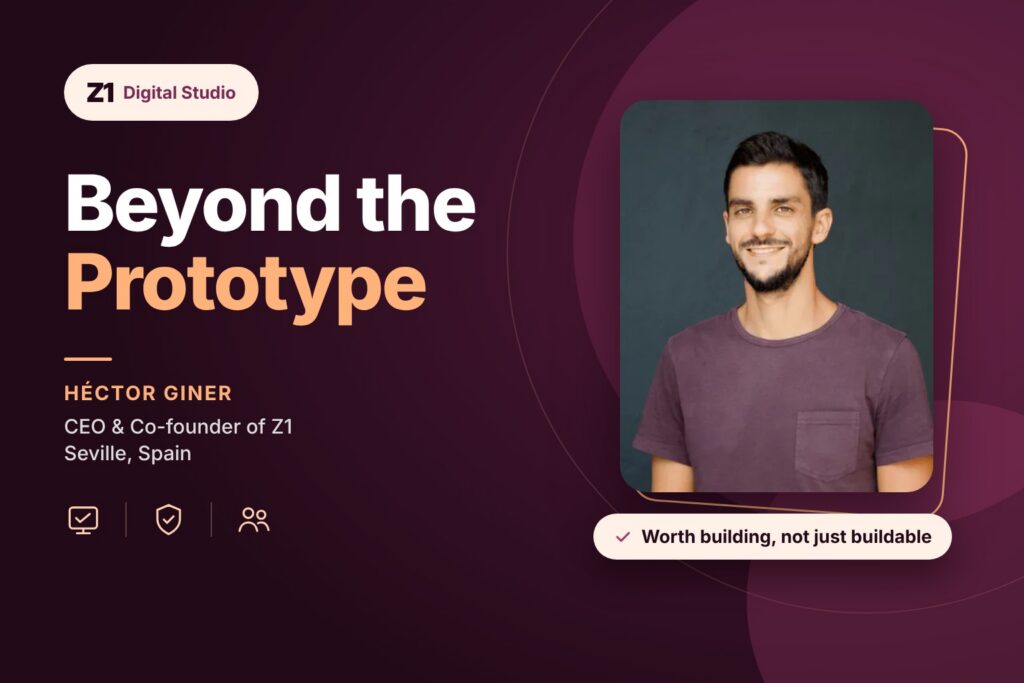
AI has made it dramatically faster to turn an idea into something tangible. But a polished prototype is not the same as a dependable product. For Héctor Giner and Z1 Digital, the harder work begins when real people start using what has been built and the product must prove that it is useful, reliable, accessible, secure, and ready to scale.
Z1 Digital brings product strategy, UX/UI design, and engineering together from the start. The studio also uses AI in its own workflows, helping teams move more quickly from strategy and information architecture to interactive prototypes while keeping experienced people responsible for judgment and quality.
Héctor Giner answered five of our questions by email. We discussed what separates a real product from a convincing demo, where AI slop enters the development process, what must feel right in a first release, how teams can balance speed with quality, and where experienced product studios will continue to make a difference.
Q&A with Héctor Giner
With AI making prototypes easier to build, what separates a real product from something that only looks convincing in a demo?
The difference is what happens when real people start using it. AI has dramatically reduced the time it takes to turn an idea into something tangible, and I think that’s fantastic. At Z1 Digital, we’re embracing this shift ourselves. We use Claude Code and Codex, to name a few, in our day-to-day work. This allows us to move from product strategy and information architecture to high-fidelity, interactive prototypes much faster than before.
But there’s an important distinction: a convincing prototype shows what’s possible, while a real product proves that it’s useful, reliable, and sustainable. Sometimes a demo can look incredibly polished while hiding fundamental problems. What happens when users behave unexpectedly, or when the product needs to handle sensitive information, integrate with existing systems, or serve thousands of people? Does the experience remain accessible and intuitive? What happens when an AI system makes a mistake or produces an unexpected result?
These questions require a deep understanding of user needs, technical architecture, security, and the real-world conditions in which the product will operate. When AI is part of the product itself, there is an additional layer of responsibility. Users need to understand what the technology can and cannot do, and the experience needs to account for the possibility that AI will sometimes get things wrong.
We help companies turn promising AI prototypes into dependable, scalable products that work beyond a controlled demonstration. We do it with AI ourselves, supported by human expertise in product strategy, UX/UI design, and engineering.
AI has made building the first version easier, but it hasn’t eliminated the challenge of making it work in the real world.
What does “AI slop” look like in practice, and where does it usually enter the product-building process?
To me, AI slop is something that might look surprisingly polished but has very little substance underneath. It could be an interface full of features nobody needs, generic content that says nothing meaningful, inconsistent user journeys, or code generated without considering the architecture or long-term maintainability of the product. I think it usually starts much earlier than people realize, with a lack of product thinking.
If you give an AI agent vague instructions, insufficient context, and no clear definition of success, it will still generate something. Because the output can look convincing, teams may mistake production for progress in solving the problem.
We’ve experienced the importance of this firsthand while developing our own AI-assisted workflows at Z1 Digital. One of our biggest learnings is that the quality of the outcome depends heavily on the foundations you provide: a clear product vision, information architecture, design principles, technical constraints, quality criteria, and meaningful feedback loops.
There is another dimension to this. Poorly considered AI-generated products can introduce accessibility problems, security vulnerabilities, misinformation, or unnecessary complexity that eventually damages user trust.
That’s why our approach to agentic development has never been about generating code faster. We want AI agents to operate within a structured process, with clear boundaries and experienced product thinkers responsible for evaluating the results.
We have one motto: The ability to generate something doesn’t make it worth building.
For me, that’s the real distinction. The goal is to use AI to create better products while preserving the judgment and care that make them valuable. Producing more and more software without product thinking is what feeds AI slop.
Z1 Digital talks about going beyond the MVP to create a “Minimum Perfect Experience.” What must feel perfect in a first release?
When we talk about a Minimum Perfect Experience, we’re not suggesting that the first version of a product needs to have every feature or that everything must be flawless. Quite the opposite. We believe the first release should be as focused as possible, but the experience around its core value proposition should be exceptional.
A traditional MVP often focuses on the minimum functionality needed to validate an idea. That’s important, but it can lead teams to underestimate the role of the experience itself. If users struggle to understand the product, don’t trust it, or encounter friction before experiencing its value, you might conclude that the idea doesn’t work when the real problem is how it was executed.
For us, the essential things are clarity, usability, reliability, and trust. People should immediately understand what the product does for them, accomplish its main task without unnecessary friction, and feel confident using it. That confidence depends on more than visual design. Accessibility, privacy, security, and transparency are fundamental parts of a good experience, not improvements to add once the product gains traction.
This becomes even more important with AI-powered products. People should know when they’re interacting with AI if that matters to their decisions, understand its limitations, and have a sensible way to recover when something goes wrong. Depending on the product, that might mean correcting an incorrect result, reversing an action, or reaching a human.
You can launch with fewer features, but not with a broken promise.
That’s the difference between simply releasing something and creating a first experience that gives people a compelling reason to come back.
Z1 Digital brings product strategy, design, and engineering together from the start. When speed and quality pull in different directions, how do you make the call?
I don’t think speed and quality have to be opposites. Often, the real problem is that teams try to move fast without knowing where they’re going. At Z1 Digital, we bring strategy, design, and engineering together from the start because it helps us make better decisions earlier, when they’re cheaper to change.
Our approach is to identify uncertainty and reduce it before making significant commitments. If the risk is technical, we might run a proof of concept, stress test, or simulation. If it’s about usability or product-market fit, we’ll use rapid prototypes and early user validation.
AI is making this process much more efficient. We can explore alternatives, create realistic prototypes, and test assumptions much faster. But that doesn’t mean we should skip validation or hand over critical decisions to an AI agent.
In fact, as AI systems become more capable of executing complex tasks independently, I think defining clear boundaries and responsibilities becomes even more important. We need to be intentional about what we automate, what requires human approval, and how we verify the results.
We’re also selective about where we compromise. We can reduce scope, simplify interactions, or postpone secondary features. But we won’t knowingly compromise what makes a product trustworthy, secure, accessible, or capable of delivering its core value.
If almost anyone can launch something quickly, where will experienced product studios like Z1 Digital still make the biggest difference?
I think the biggest difference will be in judgment. For years, building digital products required significant technical resources, and that created a barrier to entry. AI is lowering that barrier dramatically, which I see as a positive development. More people can experiment, validate ideas, and bring new solutions to life. But when everyone can build, the competitive advantage shifts from the ability to produce software to the ability to create something genuinely valuable.
That’s where I believe experienced product studios will become even more relevant as partners who can connect business goals, user needs, design decisions, and technology into products that succeed in the real world.
At Z1 Digital, we’re helping founders turn early ideas and AI-generated prototypes into market-ready products. We’re helping established companies identify meaningful opportunities to introduce AI into their existing products, from intelligent assistants to personalized experiences and agentic workflows. We’re also helping teams use AI to improve internal operations and accelerate delivery without sacrificing control or quality.
But I think our responsibility goes further than knowing how to implement the latest technology. It’s also about knowing when not to use it, recognizing the risks it introduces, and making sure the systems we create serve people rather than forcing people to adapt to the technology.
The common thread is that we start with the problem, not the technology. Sometimes AI is central to the solution; sometimes it’s simply the best tool to help us build that solution more efficiently. Sometimes the right answer doesn’t involve AI at all.
I believe the value of human expertise will become more important, not less, as these tools evolve. Technology can generate possibilities at extraordinary speed, but someone still needs to understand the business implications, challenge assumptions, make difficult trade-offs, and take responsibility for the outcome.
I think the future belongs to those who understand which problems are worth solving and can turn that understanding into exceptional products. That’s a challenge I’m genuinely excited about.
Final Thoughts
The takeaway from Héctor Giner is straightforward: generating software is not the same as creating value. AI can accelerate strategy, prototyping, design, and engineering, but it cannot replace the judgment required to choose the right problem, define a trustworthy experience, and take responsibility for the outcome.
For Z1 Digital, the opportunity is not to build more for the sake of it. It is to use faster tools without losing the product thinking that makes something worth building in the first place.
Explore More Agencies
If you’re an agency, designer, or startup looking to boost your visibility, you can join NoRobots and become part of our curated network of trusted businesses. If you’re a brand or client searching for the right partner, our platform helps you discover agencies, designers, and startups you can rely on. Browse the listings and find the right fit for your next project!