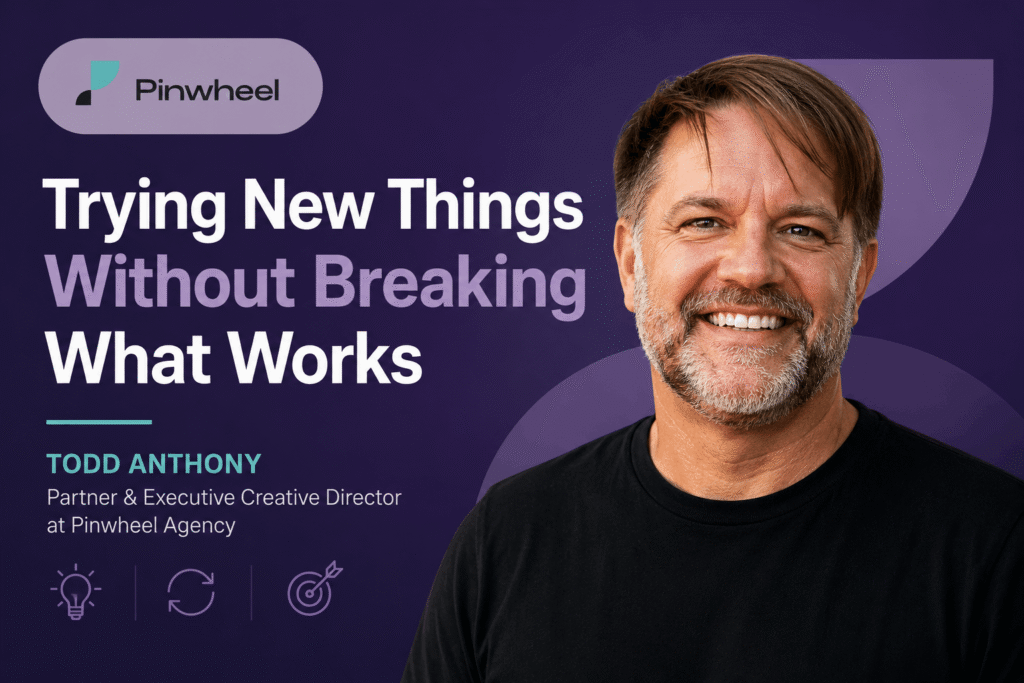
Todd Anthony is Partner and Executive Creative Director at Pinwheel Agency, which he has been running for over 12 years – a rare run in the agency world. Before Pinwheel there was another agency, a partner that didn’t work out, and a lot of lessons learned the hard way. We asked him how he tries new tools and ideas, what he does when they don’t work, and what he still wants to try.
What’s something new you’ve tried recently that changed how you work?
It really feels like “how we work” changes constantly these days. I was in a meeting with our client Stripe recently to discuss creating a graphic for one of the breakouts at their annual conference, Stripe Sessions. I had been typing careful notes as the client described what she was looking for. And I had a kind of aha moment. I thought, what if I just feed these notes into Claude right now and have it generate a prototype or rough sketch of how we understand the idea, so that we could ideate on it in real time. And I think that basically changed, for me, the nature of these complex graphical projects. Clients don’t have a lot of time these days for iteration, and a lot of the collaboration is happening async. Being able to do this IN the briefing meeting WITH the client not only speeds the process, but it improves the quality of the collaboration.
How do you test new ideas without risking client outcomes?
Well, for starters, we don’t charge for them. In fact, we’re testing a new idea right now. Working with a technology partner, we’ve built a brand health diagnostic tool that collects signals from all over the internet to basically hold up a mirror to a brand and show them how everyone else sees them. It points out things they’re doing and not doing that tend to cut against the brand image they’re trying to project out into the world. And it points out inconsistencies and the ways in which they can/should bring their brand into alignment with itself, better reach their buyers, and drive higher revenues.
So we tried it out on one of our client brands, but didn’t send it to them. We just worked on it through what we perceived to be their perspective. We knew their marketing programs, their internal challenges, and the way that they were structured. Therefore, we knew there were things in the report that they wouldn’t care about, and some things we knew they couldn’t do anything about. There were also some areas in the report that, upon further reflection, weren’t so clear. After fine-tuning the tool, we finally offered to present their brand health report to them – free of charge. They seemed enthusiastic, and the meeting went well, but they left the meeting not quite sure what to do with the information. So we’re now making the tool more actionable and useful to marketers. It’s been a fun process that only cost the client an hour of their time. And while it’s certainly an investment on our part, we think it’ll be highly valuable to current and future clients.
What’s an experiment that failed but was still worth it?
Oh my gosh, so many beautiful, glorious failures. I had an agency before I owned Pinwheel called Minty Fresh, and I took on a partner early on. At first, I thought we both wanted the same things, but then it became clear we had completely different visions for what we wanted the agency to become. And his style was absolutely NOT compatible with mine. He was more showy and braggy, and tended to stretch the truth quite a bit. Not to pat myself on the back, but I’m the exact opposite. We were 50/50 partners, and things eventually came to a head. I knew we were going to have an ugly fight over control, so I offered to sell my half to him – just as a way to avoid some of that pain and anguish. We still had to have lawyers intermediate the whole thing, and it did get pretty ugly at the end, but I gleaned some extremely valuable lessons from the whole experience: the importance of vetting your partners very thoroughly, that you should always maintain a dominant share, that you don’t need a lot of the overhead you think you need, and so on.
And, if I’m being honest with myself, I have to acknowledge that I learned a lot from him as well. The notion of having bigger ambitions, of not being afraid to self-promote (though absolutely DO NOT stretch the truth), of realizing that I’m actually really good at what I do, and so on. And all of that learning has helped me navigate the Pinwheel journey for over 12 years now – which I’ve learned is fairly rare in the agency industry.
How do you decide when a new tool, trend, or technology is worth integrating into your workflow?
We don’t have a rubric, but when a tool seems to have enough traction to gain the attention of a significant portion of our agency and client brethren, starts showing up in conversations and newsletters for a period of time, and sounds like something that will help us, we give it the ol’ college try. Some stick, some don’t. Granola is an AI notetaking app that we love very much. When AI came onto the scene, I started using a product called PrettyPrompt that automatically improved prompts – making the outputs far more useful. The models have improved since then and I don’t need it as much, but it still comes in handy. We used Trello at one point. Didn’t love it. So we switched to Airtable after we heard from other agencies that they loved that product. We also have a section of our twice-monthly marketing newsletter, the Spin, called “Tool Joy” where we review new tools that we think our marketing partners might benefit from. And I follow Product Hunt so I can stay on top of the incredibly swift pace of digital innovation that’s changing the way we work on an almost monthly basis.
As a side note, we like to think that we’re highly adaptable, and we are. But there is a cognitive load that’s getting heavier and heavier to carry due to the increasing pace of change. At some point, the cost of changing will be higher than the benefit that would be gained from that change – even if there is a clear value proposition. And that’s because we’re basically slightly smarter apes.
What’s something you want to try but haven’t had the chance yet?
I was scheduled to go skydiving about 30 years ago in the former Czechoslovakia with a friend of mine. It was going to be in a Russian plane with American parachutes, which is a configuration far superior to its opposite. We did the training. I started getting butterflies. We were about to go up, but then the wind picked up and they had to postpone for a day.
Ready to go the next day, we had a miscommunication and my friend didn’t show up to the pick-up spot. I tried finding buses to the airport, but couldn’t quite sort that out (this is pre-internet, pre-smartphone). So I never got to do it. And as I’ve gotten older, I’ve lost my nerve a little. Isn’t that funny how that works? You’ve gotten far more out of your life (in my case I’ve been married, had two kids, owned two companies, etc.), and yet you’re less inclined to risk the remaining time. Should really be the other way around, don’t you think? In any case, I’d still jump if there was an enthusiastic friend instigating it.
Final Thoughts
Todd’s approach to new things is simple: try them on your own dime, keep what works, and be honest about what didn’t – including a partnership that ended with lawyers. After 12 years at Pinwheel, that mix of curiosity and caution seems to be the thing that keeps the agency going.
Explore More Agencies
If you’re an agency, designer, or startup looking to boost your visibility, you can join Norobots and become part of our curated network of trusted businesses. If you’re a brand or client searching for the right partner, our platform helps you discover agencies, designers, and startups you can rely on. Browse the listings and find the right fit for your next project!